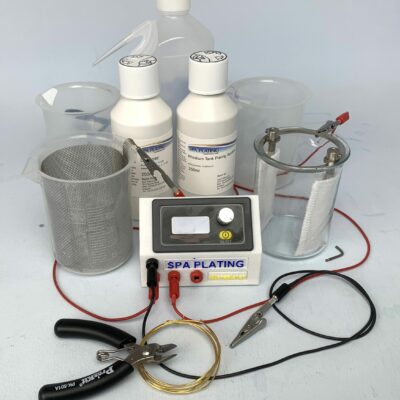
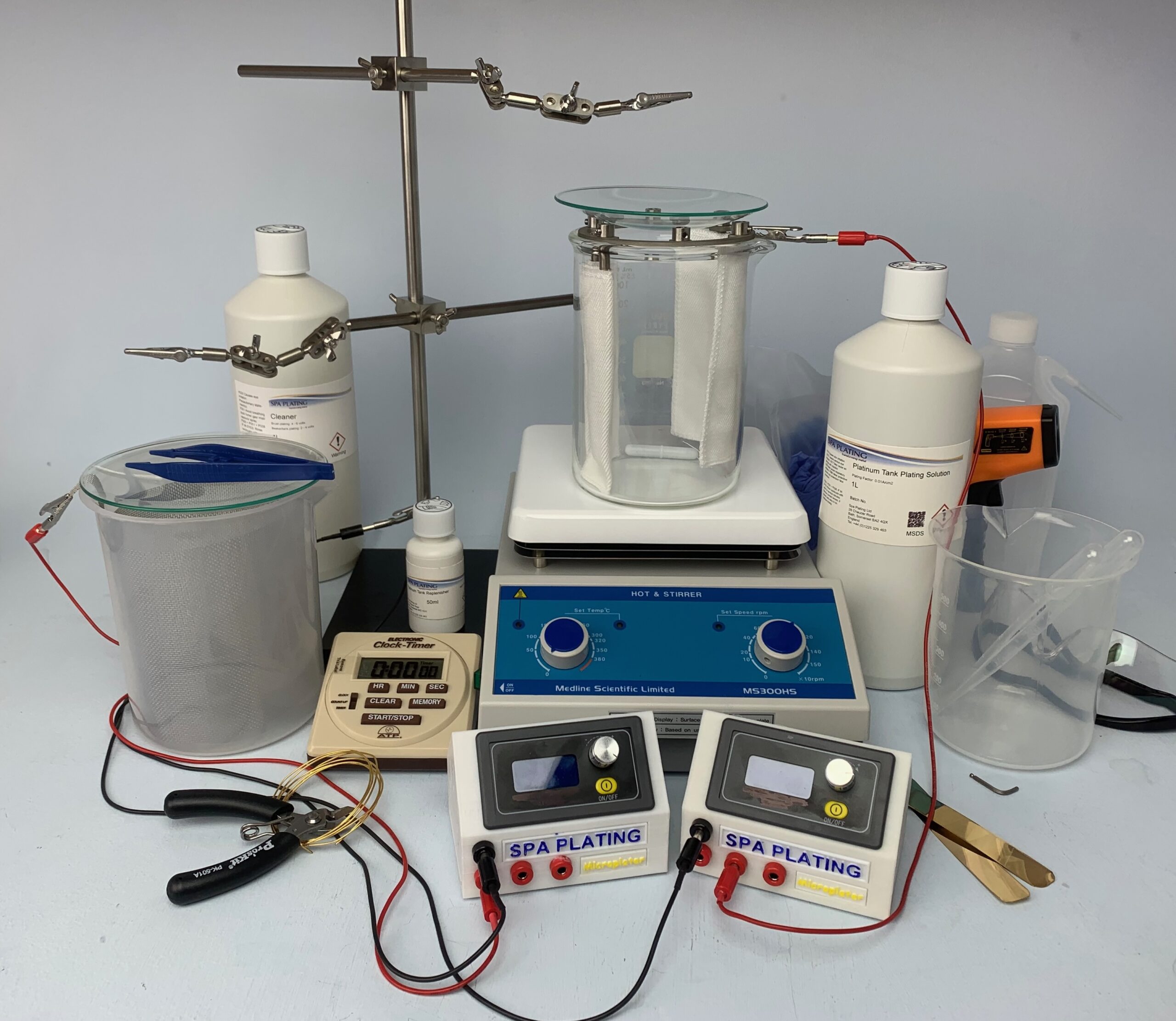
You can purchase this kit as it is or if you wish, you can use it as a guide to put together your own bespoke kit. Click on the items in the list to see detailed product information.
£1,585.65Original price was: £1,585.65.£1,551.75Current price is: £1,551.75. + VAT
We have formulated our Rhodium Tank Plating Solution with safety in mind by removing all the primary safety hazards usually associated with electroplating rhodium.
This tank plating kit is ideal for plating platinum directly onto a number of metals for example silver, gold and grit-blasted titanium.
You could consider it as an alternative for rhodium when plating white gold. However it is slightly less silvery than rhodium.
Like rhodium, you can use it to create a tarnish-free coating for items made out of silver.
One of its other main uses is for producing platinised titanium anodes with the bench-top method of plating.
Customisable
This kit is built around our MultiPlater. We have designed and built this power source to be super flexible and easy to adapt to all of our plating processes, including pen and brush plating. Please see the videos that are posted on this page under the ‘Videos’ tab and also visit our YouTube channel.
Why buy from us?
We save you time and money because…
Our plating solutions have been fully developed and tested by our in-house R&D team for optimum efficiency
We have developed unique equipment and processes that get the best out of every product we sell
Our plating calculators take the guess work out of achieving top quality plating results for the minimum time and cost.
For more help with cost and time savings, please click on the blue tabs above.
This electrode has been platinum tank plated with this kit.
We platinum plated this stone set ring with our kit and platinum tank plating solution. It plates a bright, hard wearing layer and is very suitable for items such as rings and bracelets.
Here’s a video showing how to use our platinum tank plating kit
There are a number of ways to connect up the process beakers. In this example, we're connecting up to use the minimum number of wires.
Whatever way you decide on, it's best policy to connect up with the MultiPlater switched off.
Fitting the Stainless Steel Mesh Electrode to the cleaner beaker
The plastic cleaner beaker is usually supplied with the mesh fitted, but in case that it’s not, curl the mesh into the plastic beaker and slide the mesh connector inbetween the beaker and the mesh and make sure that it’s held in place by the mesh to ensure electrical connection.
Fitting the platinum rod electrodes into the Beaker Ring and adding anode bags
Slide the non-platinum end of the electrode into the receiving hole on the beaker ring and tighten the grub screw with the allen key provided. The non platinum part of the electrode can be easily identified as it’s smooth; the platinum area is rough.
Fit the anode bags over the electrodes and place in the structure in the plating beaker.
Here’s a video to help you:
Making the Plating Stand negative (black wire)
Plug one end of the Standard Lead into the black socket of the MultiPlater and clip the other end plug into the 4mm hole located at the base of the Plating Stand.
The negative is where the plating takes place.
Connecting up the Black Jump Lead to facilitate cleaning/activation stages
Clip one end of the Black Jump Lead to the exposed portion of the black connector on the MultiPlater. Leave the other end free to clip to your workpiece when you come to plating.
Connecting up the mesh on the cleaner beaker
Plug the 4mm connector end of a Red Combination Lead into a red socket on the MultiPlater and the other end, clip to the mesh connection on the cleaner tank.
Connecting up (ganging up) the platinum plating beaker to the mesh on the cleaner beaker
Clip the crocodile clip on one end of the Red Jump Lead to the mesh of the cleaner tank then clip the other end of the Red Jump Lead to the Beaker Ring on the platinum plating beaker.
Filling the cleaner beaker and operating conditions
Fill the cleaner tank up with Cleaner until just below the level of the mesh.
Cleaner is used at room temperature and a between 2 and 4 volts.
If you prefer to control the process using amps, the plating factor for cleaner is between 0.02 – 0.03 A/cm2
Agitation is not necessary.
Filling the platinum plating beaker
Fill up with Platinum Tank Plating Solution ensuring the solution 1.5cm – 2cm below the rim of the plating beaker and that the top of the anode bags are above the level of the solution.
Platinum plating should be carried out at a cathode current density of 0.0075 amp per square centimetre, 38 – 42 degrees centigrade and extrememly low agitation or none at all.
To help calculate the MultiPlater amp setting and time that you will need to plate for, you can use our online calculator by clicking here.
While continual filtration isn’t usually necessary, occasional batch filtration or filtration through a filter pump could be advantageous.
Please click on the following links for the technical specifications of the two platinum solutions that can be used with this kit:
Certain small items, for example Swabs, Nibs and Plating Pens can be sent by normal post within the UK
The courier option for UK deliveries is FedeX and APC. Delivery times range usually from 2 – 5 working days.
Royal Mail option is available on a limited range of non-liquid orders. Delivery from 5 – 10 working days.
Free UK mainland delivery available on orders over £200
International orders usually 5 – 10 working days.
For all price quotations for deliveries, please add your items to our shopping cart. You will be able to see the shipping costs by clicking on the ‘Calculate shipping’ button in the cart and before checking out.
Plating platinum on fine and sterling silver
Degrease
Electroclean
Rinse
Platinum plate
Plating platinum on nickel and its alloys (such as nickel silver and Monel)
See also plating on freshly plated nickel below.
Degrease
Electroclean
Rinse
Plate an adhesion layer of gold with NiPrep
Rinse
Platinum plate
Plating platinum on freshly plated nickel
Keep freshly plated nickel wet after rinsing and plate directly with platinum no more than 2 minutes after leaving the nickel plating process.
Older pure nickel surfaces may be reactivated using Activator or Acticlean or perferrably manually activated with MPU
Plating platinum on copper
Degrease
Electroclean
Rinse
Acticlean/Activator dip (no power)
Rinse
Plate a layer of nickel with Nickel Tank Plating Solution to at least 1 micron.
Rinse
Platinum plate
Plating platinum on brass and bronze
Degrease
Electroclean
Rinse
Acticlean/Activator dip (no power)
Rinse
Alkaline copper flash for no longer than 30 seconds at Plating Factor: 0.01 A/cm2
Rinse
Plate a layer of nickel with Nickel Tank Plating Solution to at least 1 micron
Rinse
Platinum plate
Plating platinum on stainless steel and difficult-to-plate metals such as surgical instruments and dental alloys
Degrease
Electroclean
Rinse
Plate an adhesion layer with Gold Strike Tank
Rinse
Platinum plate
Plating platinum on to steel and iron
Degrease
Electroclean
Rinse
Plate with Alkaline Copper Tank Plating Solution for 5 minutes at plating factor 0.01 A/cm2
Rinse
Build up with Copper Tank Plating Solution (see note at end of article)
Rinse
Plate a layer of nickel with Nickel Tank Plating Solution to at least 1 micron
Rinse
Platinum plate
Plating platinum on zinc (also see individual product pages)
Plate with Alkaline Copper Tank Plating Solution for 5 minutes at plating factor 0.01 A/cm2 (see note below)
Rinse
Build up with Copper Tank Plating Solution (see note at end of article)
Rinse
Plate with Nickel Tank Plating Solution to at least 1 micron
Rinse
Platinum plate
Note : For best results, zinc needs to be mechanically finished prior to plating. This we advise polishing, linishing or very fine scratch brushing such as the finish obtained with fine Scotch-Brite™ mops. Attempting to plate on a course scratch brushed surface will result in poor adhesion and unplated areas.
Plating platinum on to aluminium
Degrease
Electroclean
Rinse
Zincate in Zincate Dip for 30 seconds to 2 minutes
Rinse
Plate with Alkaline Copper Tank Plating Solution for 5 minutes at plating factor 0.01 A/cm
Rinse
Build up with Copper Tank Plating Solution (see note at end of article)
Nickel plate with Nickel Tank Plating Solution to at least 1 micron
Rinse
Platinum plate
Plating platinum on tin and its alloys (pewter, Britannia metal and solder)
Degrease
Electroclean
Rinse
Plate with Alkaline Copper Tank Plating Solution for 5 minutes at plating factor 0.01 A/cm
Rinse
Plate with Nickel Tank Plating Solution to at least 1 micron.
Rinse
Platinum plate
More information about each process can found on the individual product pages.
Note 1: The process sequences outlined above apply only to Platinum Tank Plating Solution (UK and EU only) and not to Platinum Tank Plating Solution (Available worldwide).